Warning: this post is a bit self-indulgent. I will review my collaborations with dancers in a musical context over the past three years and attempt to draw a thread from these to my current projects.
My first project that featured a dancer-musician collaboration was counter(Projections). This project was presented in Spring 2014 in NYC with Hajnal Pivnick and Diane Skerbec of TENTH INTERVENTION.
Besides the performers themselves, the performance calls for 3 large screens, 2 webcams, an adjustable aperture light, live audio and video processing/playback, cued soundfiles, and a few light cues triggered from the back of the hall. I should mention that a caveat of working with dancers is that often these works only get performed once. My ambitions in dance pieces usually exceed what is economical/tour-able, and my more convenient pieces tend to be performed more. However, perhaps the most glaring factor that contributes to the untourability (cough) of these works is that independent musicians don't typically tour with dancers, especially if the dancer is just featured on once piece. Anyways, back to the piece...
The choreography in (counter)Projections was inspired by the physical and gestural nature of violin performance. The program notes state:
Movement suggests sound just as sound provokes movement. But what about when the two don't agree? Can a violent gesture change the way we hear a melancholic sound, just as an aggressive sound can change the way we see a graceful movement? How do these incongruencies change our perception?
This work, (counter)Projections, is a performance scored for amplified violinist, dancer, live electronics, and live video projections. The dancer's role here by and large is to perform a physical and gestural amplification of the connection the musician has with their violin. Through this connection, the body itself becomes musical material. The piece is based on the tensions and resolutions of this relationship, how it builds up and decays. It is, fundamentally, this idea that formed the conception of this work.
The dancer's part included a list of terms.
Physical Mimicry (PM): The dancer should move as if she is holding an imaginary violin. She should mimic the movements of the violinist, but she doesn’t have to limit herself to the detail.
Gestural Mimicry (GM): The dancer’s movement should be inspired by the movement and aggressiveness, fragility, jumpiness, smoothness, etc, of the sound. Try to draw as many relationships between the sound and movement as possible, without making a direct
Physical-Gestural Mimicry (PGM): A combination of PM and GM. Perhaps the macromovement (the general position of major extremities) is guided by PM, but micromovements (little twists in the torso and back, wrists, fingers, neck) are guided by GM.
Contra-Physical Mimicry (C-PM): Take PM into consideration, but move in a stylistically opposing way.
Contra-Gestural Mimicry (C-GM): Take GM into consideration, but move in a stylistically opposing way.
Though the program notes tell a more poetic story, you can see that all the choreography is pretty violin-centric. The violin part is more or less fixed, and the dancer must either memorize the violin part, or keep an eye on the musician during the performance (dancers don't read instructions while performing, and sometimes I feel that musicians shouldn't either...). I feel that both of these tasks inhibit the dancer from fully committing to the moment of the performance.
Diane's part was created by combining her understanding of Hajnal's movements, how the music made her move gesturally, and my critiques. Besides the terms (GM/PM, etc.), she created much of the moment-to-moment choreography, and it is not written in the score. This was done during intense workshop sessions in NYC which took place sporadically in the weeks prior to the performance. I'll compare and contrast dancer/musician rehearsal culture in a later entry.
The problems in (counter)Projections is that the it leaves the music-dance-power structure untouched. When I speak about this power structure, I'm referring to the fact that in most dance performances, the dancers perform to prerecorded tracks or live musicians playing fixed music (i.e. Stravinsky's Rite of Spring). In performance situations, I rarely see musicians actively interpreting dancers and changing the way they play their instruments to accompany them (the dancers). At no moment in (counter)Projections does the violinist react to the dancer. The flow of information is unidirectional and static - though I didn't realize this until several months afterwards...
--
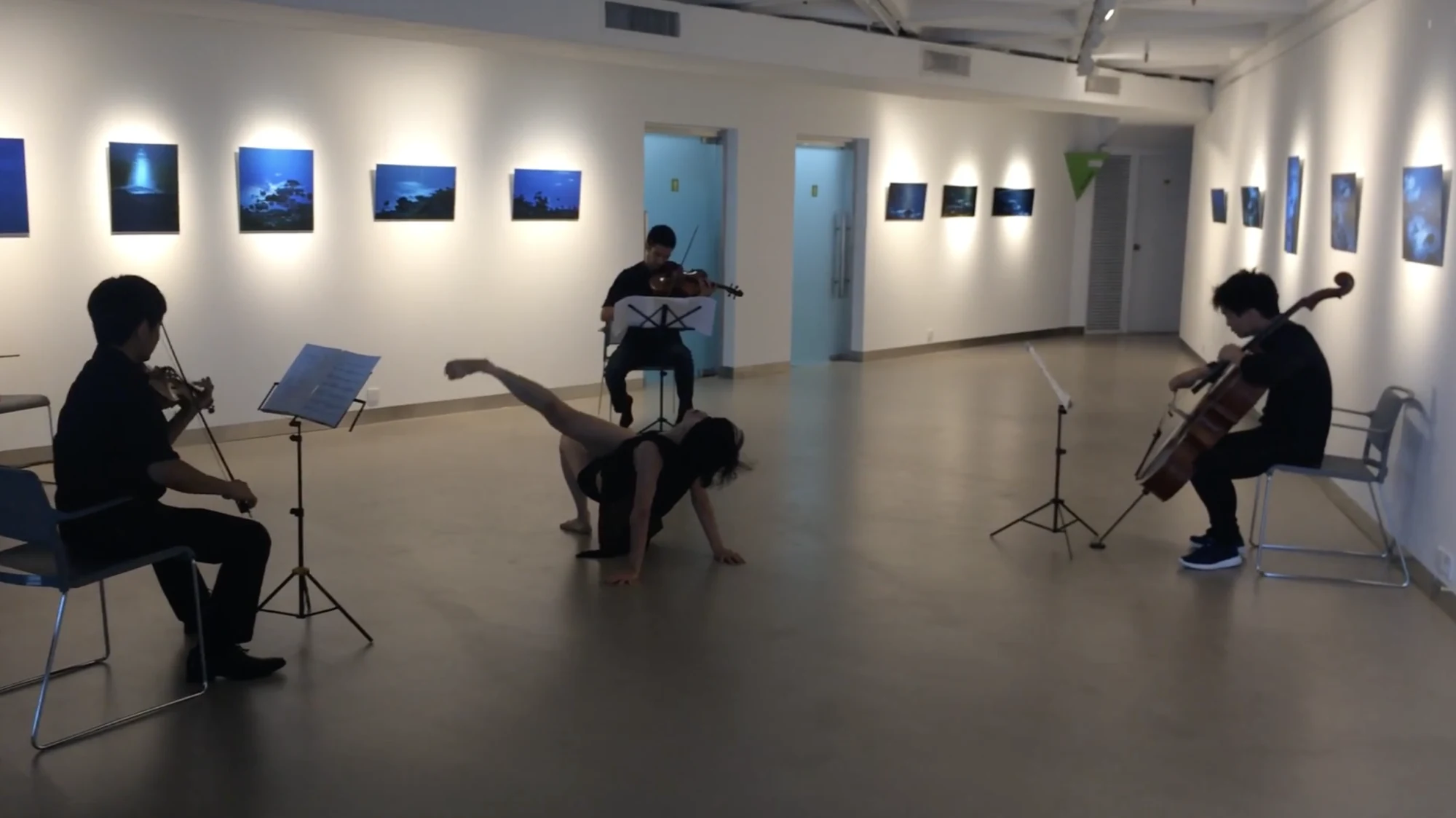
My second dancer-musician collaboration was Humid Gravity, written for Ensemble Gô and dancer Sarah Xiao. It was premiered in July 2015 in Hong Kong. This video is an iphone recording of the dress rehearsal, and is only meant for pedagogical purposes.
Though this piece has been performed by other ensembles following the premiere (including Chartreuse and Mosa Tsay's Celloscape Collective), it has only been performed with a dancer once. The conceptual approach here is similar to (counter)Projections: the dancer reacts to the musicians. In this piece, the musicians surround the dancer in a triangle, and the audience surrounds the musicians. This arrangement produces a more spatially engaging situation for the dancer. Instead of playing solely to the front of the room, the Sarah explores all 360 degrees of space surrounding her, opening up her movements in all directions.
Instead of the choreography being based on the physicality of instrumental performance, Sarah treats the musicians as gravitational forces that attract and repel her in various ways based on what they're playing. The musician's parts are totally fixed, and Sarah established behaviors and motivations for each section of the piece. These behaviors are not written in the score.
Like before, the information flows one way. The fact that Sarah is blindfolded during the performances further alludes to this power structure. Though her movements at times are extroverted and ambitious, they are still at the mercy of the sounds (and the musicians playing them). This performance paradigm was adopted due to the rehearsal timeline of the piece. We were not granted ample time to explore and rework the material as an ensemble, and the musicians were not comfortable improvising with such short notice (dancers are usually more comfortable improvisers than classically-trained musicians – more on that later). Though these were less-than-ideal circumstances, we adapted. C’est la vie.
Ok, 1000 words and 2 videos is more than enough for this entry. In part 2, I will review my 2016 collaboration with Thin Edge New Music Collective. 2016 was my first year exploring motion-sensitive live electronics and performing free improvisation on my viola, and it totally changed my working methods.