Sometimes when you start a project, its nature changes a million times before the performance.
In Spring 2023, I felt the need to change my artistic practice. I had been working with motion sensor chips and dancers and musicians for a while, following similar patterns and formulas, and I needed a shift in perspective. Having just come back from a tour in Austria, visual art was fresh on my mind, and I wanted to explore relationships between 2D visual-art-making and sound.
How could I translate the act of making 2D visual art to sound? Contact microphones on canvas that pick up the artist’s actions? Overhead camera tracking the hand of the artist and the resulting lines and colors?
My first instinct was to talk to artists. I got in contact with saxophonist and visual artist Christopher Moore and we started having sessions together in my studio. I reached out to Christopher because he’s a brilliant improviser and visual artist. The idea was that he’d be the visual artist-sound creator, and I’d be the computer operator.
For these sessions, I taped a piece of paper to a hard surface, attached a contact mic to the middle of the paper, and ran the mic into a MaxMSP patch. I put an amplitude listener on the mic level and fed it into some virtual instrument models. The idea behind this flow was that the gesture of the artist’s tool on the paper would trigger an electronic virtual instrument, and that gestures that were more dramatic or closer to the microphone would produce a larger sound. For virtual instruments, I used the Modalys library in MaxMSP to create virtual strings, pipes, and membranes. Here's a sample:
For visuals, I envisioned a situation where there’d be a camera above the canvas that would capture the artist’s hand and their work. The data from the artist’s hand position would be used somehow in the sound.
Additionally, this scene would be projected into the space. Similar to my viola solo, I’d want to use the sound generated by the scene to distort the projections. But first:
Theatrical Concerns
Is watching someone paint interesting? What is the process behind making 2D art?
How much time does 2D art making take? What size canvas do artists work with? What would have to be true for the process
of painting to be captivating as a performance?
With the performer authoring both the
painting AND the sound, is it too much for one person? Will the performer end up compromising the quality of one for the other?
Similar to the previous project described in this series, would this situation need framing and
dramaturgy? Is the premise alone enough?
Technological Concerns
Music is a time-based art where each moment is liminal. Live painting has
time-based elements, but the residue of the artist’s actions is more or less permanent on the canvas. Regarding the
notion of the computer “seeing” what the artist is doing, should the computer acknowledge the entire work, or just
whatever is most “new” while forgetting what has already happened?
What should
the computer track and how? The artist’s hand? The artist’s creation? How should I configure Isadora’s blob tracking
feature? Does the artist’s hand need to be a specific color?
-
Is it ethical to distort an artist’s drawing with a computer while it's being drawn?
Change is the Only Constant
Is watching someone paint interesting? What is the process behind making 2D art? How much time does 2D art making take? What size canvas do artists work with? What would have to be true for the process of painting to be captivating as a performance?
With the performer authoring both the painting AND the sound, is it too much for one person? Will the performer end up compromising the quality of one for the other?
Similar to the previous project described in this series, would this situation need framing and dramaturgy? Is the premise alone enough?
Music is a time-based art where each moment is liminal. Live painting has time-based elements, but the residue of the artist’s actions is more or less permanent on the canvas. Regarding the notion of the computer “seeing” what the artist is doing, should the computer acknowledge the entire work, or just whatever is most “new” while forgetting what has already happened?
What should the computer track and how? The artist’s hand? The artist’s creation? How should I configure Isadora’s blob tracking feature? Does the artist’s hand need to be a specific color?
Is it ethical to distort an artist’s drawing with a computer while it's being drawn?
With these questions in mind, I built the instrument, and we played around with it. Every time Christopher came over, our ideas would change. What if the canvas was metal? Or wood? What if we used charcoal? Or Pastel?
After several weeks, Christopher said that it was too much to author both the visual art and sound at the same time. If you concentrate too much on the art, the sound suffers, and vice versa.
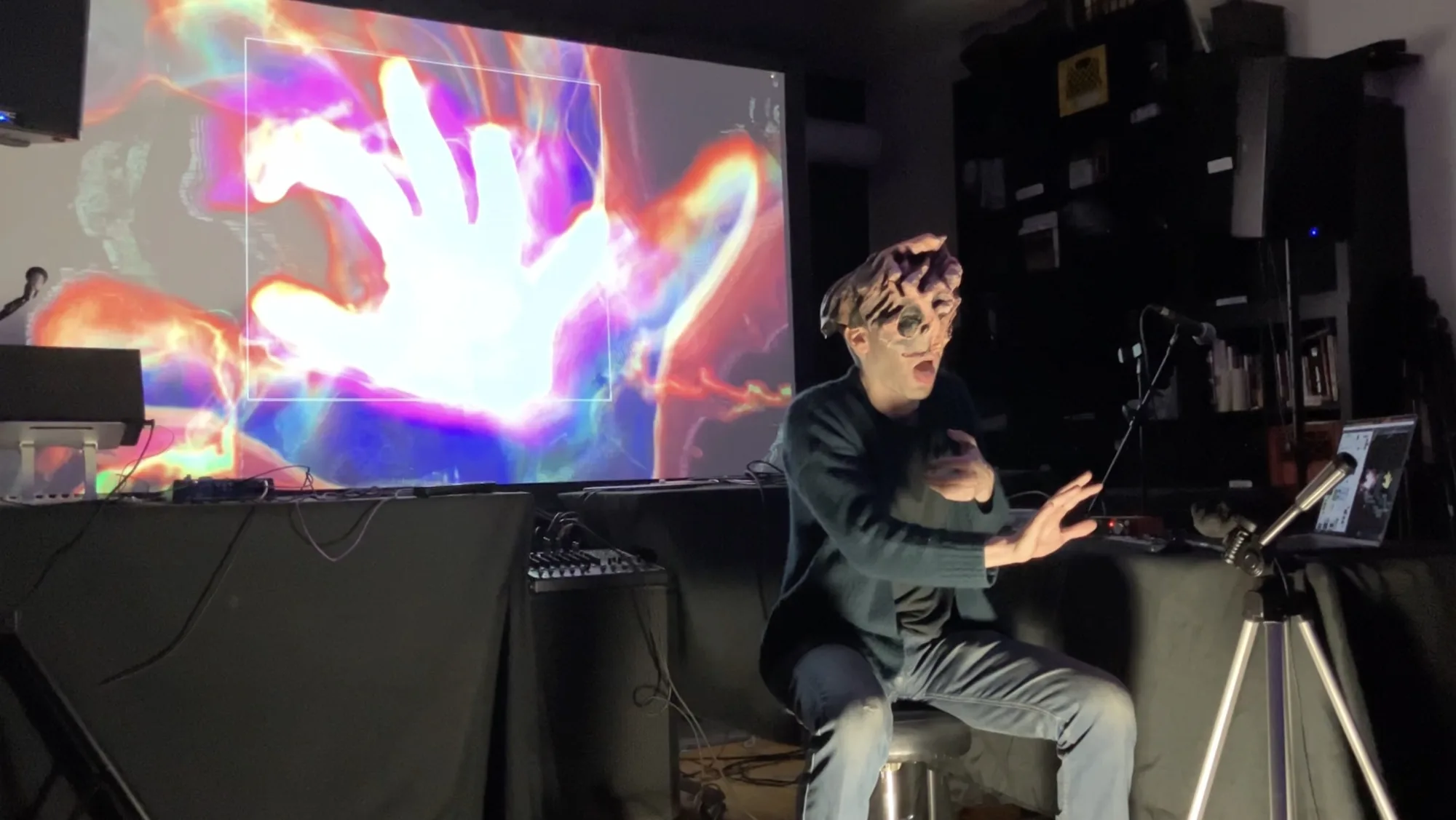
He told me about his Reiki practices, about moving energy with his hands. We decided to replace the canvas with a mirror. I attached the contact mic to the mirror, which would sit on Christopher’s lap. The mic would pick up his contact with the mirror, and the camera would pick up the position of his hands and their reflection in the mirror. Christopher would then use his hands to "sculpt" the sound. Here's how it looked in the room.
And here's how it looked on the screen:
That's enough for now, more later.