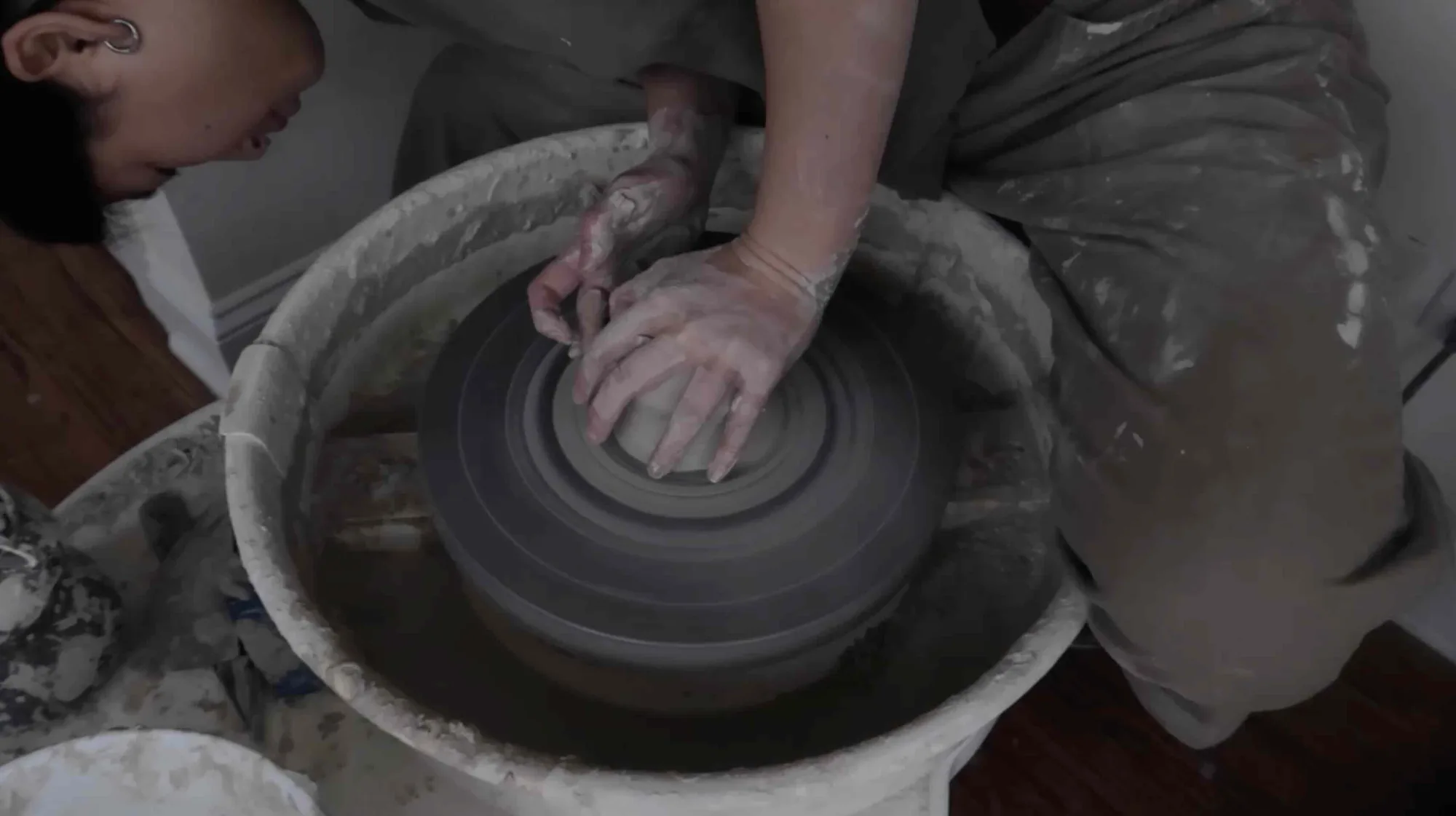
I’m writing this in anticipation of the premiere of a new work called Ancient Futures. This is an interdisciplinary collaboration between me and QuJie that centers clay-shaping as performance. The premiere is May 22 at Elastic Arts, and I wanted to take a moment to lay the background for this piece.
I’ve been wanting to explore the idea of “visual art as performance” for a while but struggled to find a good frame. My solo performance “Digital Hands” was originally a duo with saxophonist and visual artist Christopher Moore where I tried to make a system where the visual artist would generate the sound through their gestures on the canvas. However, it gradually became evident that producing a drawing and compelling sound simultaneously was too much for one performer.
There are artists who do live-painting as performance, and there are dancers who use their bodies as paint brushes, but it seems that in these instances, one discipline takes dominance over the other.
Some examples:
Classic Bob Ross
Speed-painting competition
This performance has a “wow-moment” when the artists flips their canvas upside down to reveal the portrait.
Dancer using paint to make very abstract creations
A performance I did with dancer Tamara Chu and musicians Danishta Rivero Castro and Jacob Felix Heule
I think the problem we kept running into was the permanence of the visual. We judge a canvas after paint has been applied. Does the canvas’s final character relate to the music that was created by the artist during the process?
What makes ceramics different from painting is that you can go through many create-destroy cycles using the same material. Rather than looking at a blank canvas, you’re looking at a chunk of wet clay. The canvas is the space over the wheel, and you have the freedom to put clay in the space.
After music happens, its energy stays in your body, but we don’t see the air that was patterned. We can say the same about dance, but to a lesser extent. Dance performances are more likely to change the performance space visually than a music performance, but we usually don’t get to see traces of the dancers movements after they occur.
These ponderings lead me to seek out a dancer-ceramicist collaborator. Would it be possible to work with someone who could blend the physical languages of dance and clay-shaping? QuJie is a dancer and ceramicist in Chicago who I've worked with before in a group situation. When I pitched the idea to them, they hopped onboard. More soon.