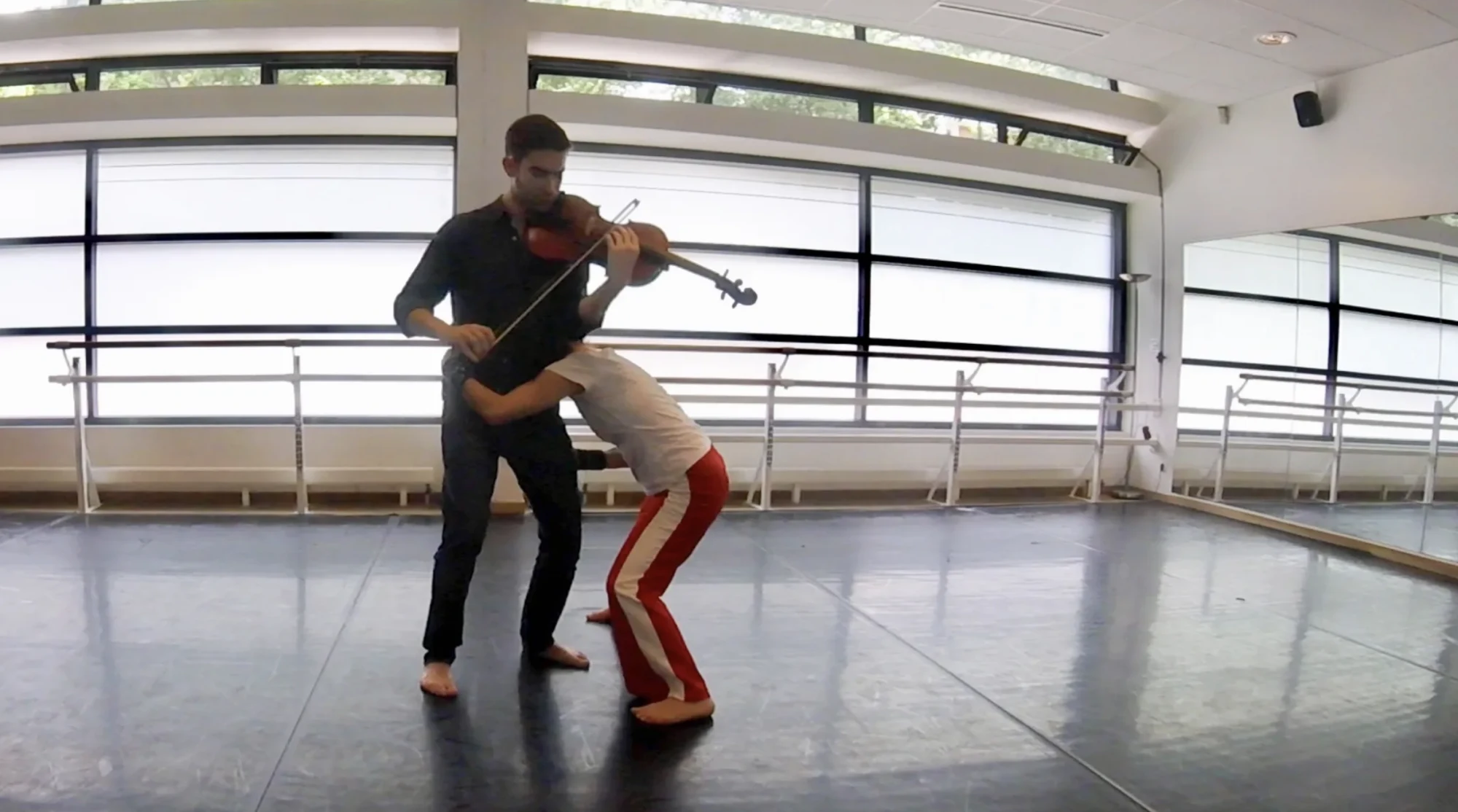
This entry will wrap up my sessions with Bonansea and Papazoglou, concluding with some thoughts regarding social behavior theories in improvisation.
Body scores:
These next two sessions involved Margarite performing short body-scores on me - that is, a sequence of touches, scrapes, and presses on my passive body. Both of these sessions were done without electronics, thus the sound is purely acoustic. In this first clip, she improvises a body score as I stand idle without the instrument. About halfway through the clip, I perform a short improvised interpretation/response to her score (as it exists in my memory), translating the qualities of her touch (rhythm, articulation, location) into musical gestures.
In the next clip, we use the same concept, but the interpretation between touch and sound happens in real time:
I have never experienced an interaction like this before as a musician. Sure, I’ve danced with dancers (Lindy hop and more contemporary stuff), taken part in group dance workshops, but I’ve never experienced touch with the goal of interpreting it as musical actions with my instrument. This was, for me, perhaps the most intense and intimate part of our session. No computers were involved, my eyes were closed, and my body was listening and experiencing with utmost sensitivity.
Thoughts on playing with or without electronics
This session also got me thinking about the consequences of performing with or without motion sensors and live electronic sound. With regards to myself as a violist, playing with live electronic sound lets me easily extend my sound beyond the sonic and spatial capabilities of my instrument. The electronic layers give me additional contrapuntal textures to play with (or against).
I’d like to clarify this by referencing the threshold model of social behavior proposed by Thomas Schelling and later sociologist Mark Granovetter (popularized in Malcolm Gladwell's book The Tipping Point). To put it simply (and reductively), we are more inclined to exhibit behaviors when they are being (or have already been) done/contextualized/normalized by others. Relating this back to improvisation, I find that this can be used to explain certain musical/artistic behaviors. While playing alone, we have nothing to reaffirm or contextualize our actions other than ourselves. This puts an enormous amount of pressure on the performer (especially in public concerts) as the sole generator of the performance material. Personally, I find it less frightening to navigate improvised environments in small groups. It’s easier for me to converse with others and contribute to an ongoing discourse than to be expected to constantly have something to say. Others give me questions to answer and behaviors to support (and subvert). Others can be human or machine, musicians or dancers.
Improvising with live electronics has this effect. By producing a semi-controllable extension of my sound, it’s akin to having a posse of backup musicians playing semi-human semi-deviant heterophony in real time. I can create something and follow it if I wish, and it takes little effort for me to follow a texture into previously unknown sonic environments. I don’t have to be the sole creative musical agent, and this can be a relief. The electronics immediately provide layers of sound that contextualize my "mistakes", adding weight to approach the tipping point (that is, the point of accepting a particular behavior as musical performance, rather than a human sawing away at strings attached to a wooden box), normalizing what may be strange unorthodox viola playing, ultimately making me feel slightly-less crazy about what I’m doing.
Regarding the dancer, most dancers whom I've worked with feel an immense sense of power when I attach the sensors to their arms. They love taking an active role in the sound, like a superpower commanding a semi-broken/ semi-autonomous/ semi-stubborn machine. Having this feeling though can sometimes “damage” the style of the movement, as they usually begin by dancing solely to create data. I always ask the dancer to forget that they’re wearing sensors and to dance authentically, but this is easier said than done. Also, dancers are sometimes is deceived by the sensor’s purpose. Since the patch only works if there’s sound in the buffer (which is filled in real time by me), there isn’t always sound to work with. If the dancer moves with the intent on producing a sound, and there isn’t one, they usually give me a confused look and ask me why it doesn’t work. The semi-autonomous/subversive nature of the patch isn’t always clear, nor do I want it to be. Though I built the patch to function as a digital marriage between the dancer’s movement data and the musician’s sound, it can actually hinder the relationship between the performers, acting at times like an annoying and mischievous third performer.
Of course, playing solo acoustic music also has its place. I am more intimately connected to my sound, and if I want a sound a complex polyphonic texture to exist, I must labor to create it. This is at times an arduous task that requires a lot of courage and focus. For dancers, this is their normal. They usually feel more connected with me, and our relationship feels more exposed and direct.
One recent question I asked myself: how would my practice change if I played another instrument other than viola, say flute, percussion, or bassoon? The viola is an instrument that can be played standing, and the geometric position of the body and the object provides for certain affordances of physical interaction with a dancer. How would a dancer’s approach change if I played french horn?
Future developments
One of my next projects will be to create a small ensemble of 2-3 dancers and 3-4 musicians, using a more developed system of motion-sensitive live electronics. I want to work with a quasi-permanent roster of performers with whom I can develop and explore more complex improvisational environments, performance practices, and flexible long-form structures. One of my goals for this ensemble is to be able to create 30-45 minute sets performed from memory. I’ve never done or seen something like this before. Let’s see if it’s possible.