In the last article of this series, I’m going to present a fifth etude, along with an overall analysis what this all means..
Broken Loop
In “Broken Loop”, each player independently picks three ideas to improvise on. The improvisation should be a succession of these ideas. After they pass through each idea, they play a ‘wildcard’ idea. They should vary the amount of time spent on each idea and changes of ideas are not coordinated. The ‘wildcard’ idea does not have to be the same at each iteration.
Player A: 1--------2-----3-----?----1------2-----3----?----1----2----3----?-----
Player B: 1---2----------3-?---------1---2-3-----?---1-------2--3----?-----------
The goal of this etudes is to construct unsynchronized aperiodic loops, resulting in composite textures of ordered familiar material with unfamiliar superimpositions.
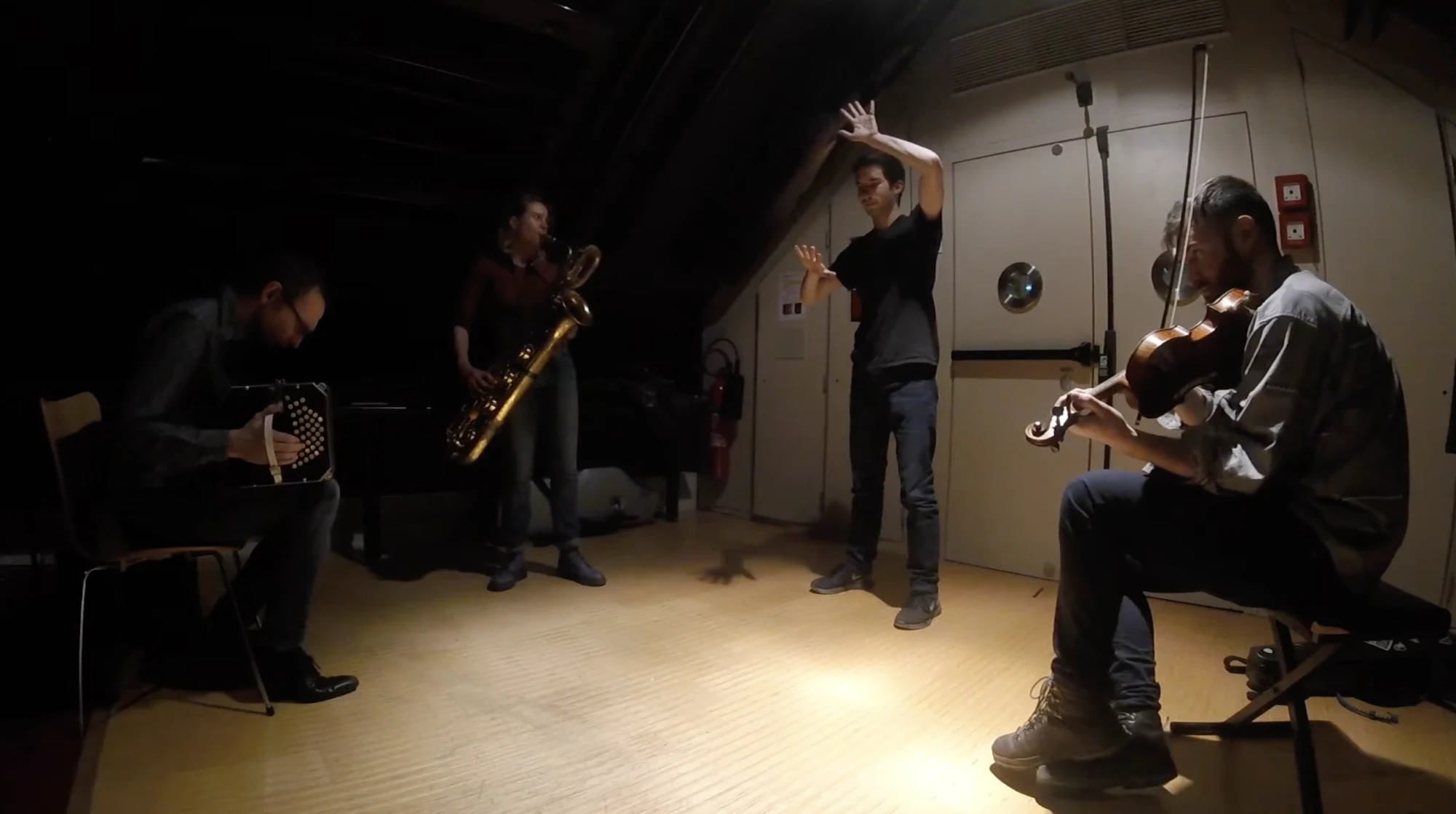
As you can see in the video, I chose three basic hand gestures to serve as my ideas: 1) hands clasped together in a fist, 2) hands flat and parallel with the fingertips of my fingers touching, and 3) hands apart moving in a coordinated fashion. You can loosely hear how each musician takes their own approach to choosing material, looping it, and changing it over time. If I had more time to work with the musicians on this etude, we might pre-establish everyone's ideas ahead of time to create a bit more cohesion.
I think this etude works because players have more confidence regarding what they were going to play next in a general sense. Rather than having to constantly produce new material or follow some abstract interpretation process, the performers, for the most part, simply riffs on a couple of ideas. This etude, thus, isn’t so much concerned with a convoluted method of cross-modal interpretation, but simply a way of creating a semi-repetitive structure. I allude this towards Varese’s notion of musical layers as tectonic plates; constantly shifting and evolving threads of material, pushing and sliding against each other, changing each other’s identity.
Concluding thoughts
What do I want to do with all of this? What is my motivation in pursuing improvisation-based performance practices?
I consider my sonic language partly an extension of my connection with my viola. I was trained as a classical violist, but I fell out of practice when I started composing. My style of playing changed from being note-based (e.g., running through 3-octave scales) to being more grounded in my physical connection with the object, resulting on a focus of more gesture- and noise-based sounds. If you’re curious to hear more, here’s a short improvisation I made recently.
I improvised the top-left layer first, and then improvised each subsequent layer while listening to the previous ones, superimposing them as I go. My plan is to extend and notate this music into a string quartet. Of course, this is a long and tedious process, but it’s more of a personal goal of notating complex improvised sounds and creating something that can guarantee a higher degree of reproducibility.
So where is my ideal situation in all of this? I think one reason for this research is to discover a way to access, formalize, and refine my sonic language in the most efficient way possible. I realize that this sounds painfully capitalistic, and a bit lazy. To be honest, I’m frustrated with the inherent inefficiencies of academic new music. First, composers find an opportunity to work with an ensemble (most likely through their university, winning a competition, attending (and sometimes paying for) a workshop/master-class/festival, or professional connections). Next, they spend several months (or in most cases, not enough time) painstakingly notating music that will get 3 hours of rehearsal, and 1 or 2 performances (if they’re lucky). Usually there is little time for corrections or changes. Hopefully, they get a good recording/video of the concert so they can immortalize their work on the internet. I want a way to iterate small ideas faster, so I can have more confidence while creating a more substantial work.
Still, I’m a composer with personal tastes, and, these etudes do not access my musical language by default. It’s simply a filter for the language of the improvisers. In an ideal performance situation, I’d want to work more with the performers to sculpt the material to my satisfaction. The question is how to get there…
I think one glaring pitfall in my approach is that my artistic value system contradicts itself. This system describes performance material and its implementation:
I want to use complex textures (comprised of rapidly-changing musical parameters with a degree of spontaneity) without using complex notation. I don’t want to use complex notation because 1) it takes a long time to write and engrave, and 2) it takes a long time to learn and is difficult to memorize.
I want to create a concert practice where players perform from memory. Other art forms go through great lengths so that their performances can appear to be completely embodied. Actors, opera singers, and dancers don’t carry a script onto the stage. Politicians use transparent teleprompters to improve their stage presence. Classical musicians have it easy when it comes to audience expectations, meaning that it takes very little for the audience to “buy-in” to the performance. The moment a musician plays a note, we tell ourselves that the performance has begun. Actors and dancers must find other ways to stylize their behaviors in order to achieve the same effect.
In a situation where dancers and musicians perform together, the work should be interactive and memorized. How can this be done without a score?
Thus, it seems that these values work against each other, and I’ve backed myself into a conceptual corner. While I’m still young and “emerging”, I guess I will have to compromise parts of this system in my art while I work to create the means to approach the ideal. It would be incredible if composers could work with performers like how choreographers have with dancers. Teaching by demonstration, improvising and sculpting material together, gradually memorizing everything as its taught. Yes, this presents numerous problems that I’ve gone over before, but one can dream, right?
I’ve already sent these etudes to a few calls-for-scores. For those unfamiliar with this term, this refers to ads posted by institutions or ensembles that are aimed at composers. Simply put, they ask composers to send them music or proposals that fall under certain conditions, from which they select some to perform. In my applications, I usually include a small comment that states something like:
“This score combines improvising musicians with an improvising dancer under very strict performance and rehearsal conditions. In the past, the implementations that I have made of this work are a result of the interaction between the ensemble with the score, and also my personal interaction with the ensemble. These etudes are a tool for generating material, discovering how the ensemble interacts with itself, and using these interactions to shape a longer work. Since the improvised material is generated by and for the ensemble, it is easily memorized for the performance. This work, a collaboration between the musicians, the dancer, and the composer, all take place during the rehearsal process. It’s less of a thing and more of an act or a process.”
I’m excited to see where this all goes. In the meantime, I’ll keep searching.