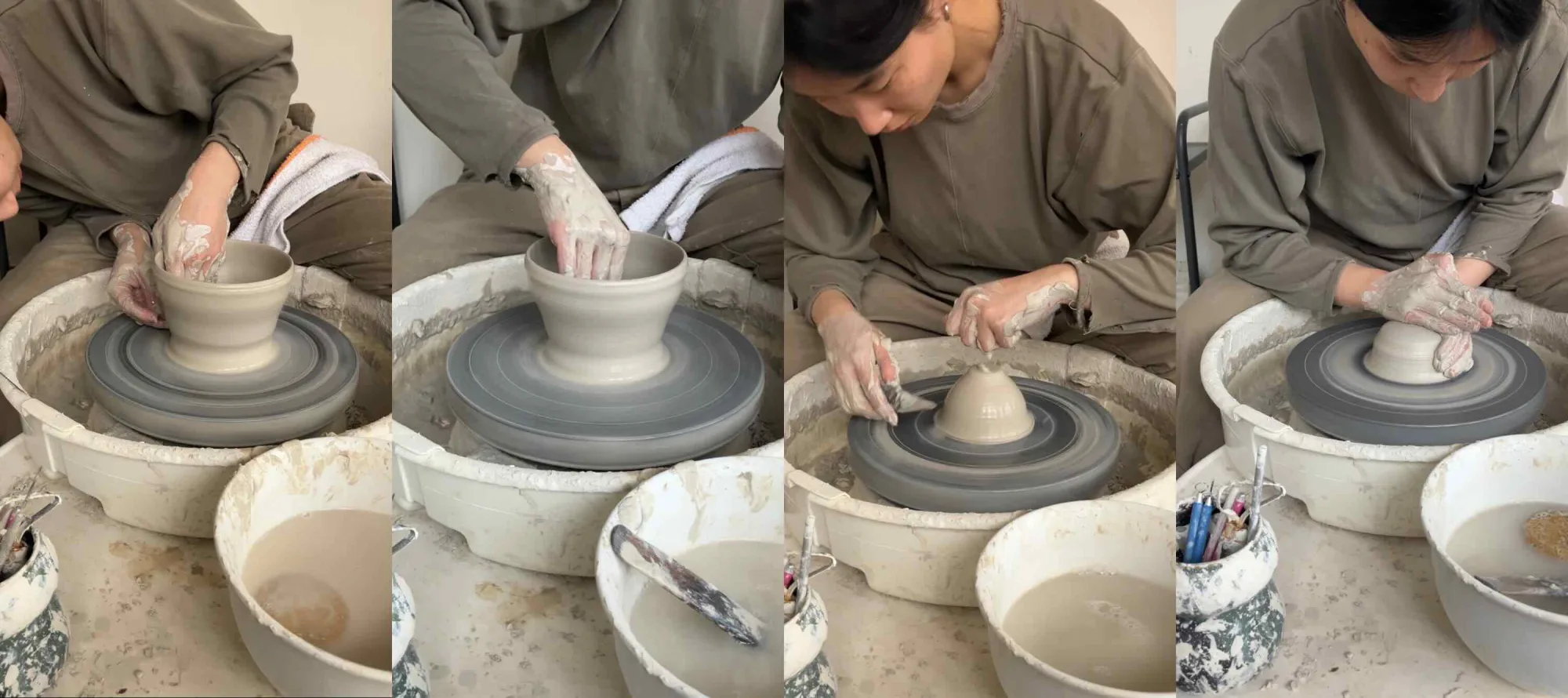
Honestly, it sounds interesting but not spectacular. Finished ceramic objects sound much more compelling. When QuJie and I had our first session, we set up a camera and microphone to take samples, and QuJie did their thing. Kneading the clay, throwing it on the wheel, centering it, wetting it, shaping it, trimming it, cleaning the wheel, and using various tools. Here’s a short clip.
I realised that shaping the clay with your hands sounds more intriguing in your head than it does in real life. The motions that shape the clay can be very small and precise. They don’t feel performative, but more functional. The intention is different.
Thus, we were faced with the questions “is this performative”, “should this be performative”, “how could this be performative”, and “what does it mean to be performative”. People do pottery to make things. Pottery can be performative in a pedagogical way, but not in the same way that dance is performative. But is the point of the performance to shape clay properly? Not necessarily. The point of the performance is to say what we wanna say.
This leads into the question of intention; specifically, how to mix dance-intention with sound-intention with pottery-intention.
Dance-intention is probably the most flexible. Stylize a movement, give it a character or quality, play with the movement. Sound-intentsion comes next: the movement’s purpose is to create a sound. The quality of the movement comes second to the audible byproduct. The visual aspect may not be super exciting, but that isn’t what we want the audience to perceive. Maybe there’s a sonic pattern that’s developing. Lastly comes pottery-intention. Obviously, the purpose is to shape the clay, and the sonic and visual qualities of the movement come second.
Juxtaposing and blending these 3 intentions together is a tough job, and this question was one of the main pillars of our collaboration. Still, this doesn’t answer the question of the performance’s core purpose (other than for its own sake).
Wrapping this up by going back to the first issue, if the pottery wheel doesn’t sound as amazing as you thought it would, how do you find the compromise between the sounds in your head and the sounds in front of you? By stretching the truth with electronics :) Blend the real with the digital. Of course, there’s the method of [mic+fuzz+harmonizer+reverb], but what else? Cameras, sensors, and expanding the scope of the performance towards dance-theater…