I sometimes evaluate my own work as an artifact of my past self. Composers sometimes joke that listening to old recordings of earlier pieces conjure up feelings similar to when we read adolescent diary entries. These artifacts are a marker of what we cared about, our environments, the problems we were confronting, the people we were working with, and what we wanted to say. At pivotal moments in my life, I usually pause to reflect on these markers, how my ideas about music and performance have changed, what I’ve learned while working through these projects, and how to move forward.
On the eve of my PhD qualifying exams (yes, they're tomorrow), I can’t help but explore ways to contextualize my past and present work with regards to the many trajectories of 20th and 21st century musical performance.
Three years ago, I left Montreal to begin my doctoral studies at UC Berkeley. The last piece I wrote before I left was the Bath Clown Duo for Jeff Stonehouse and Gabrielle Gingras; two friends from Ensemble Paramirabo.
Looking back on it, one can hear (putting aside questionable recording/mixing techniques) piano writing suggestive of Beat Furrer, gradually-unfolding repetitive structures of Philippe Leroux, and percussive flute playing reminiscent of beat-boxing; everything well within the confines of your traditional concert experience.
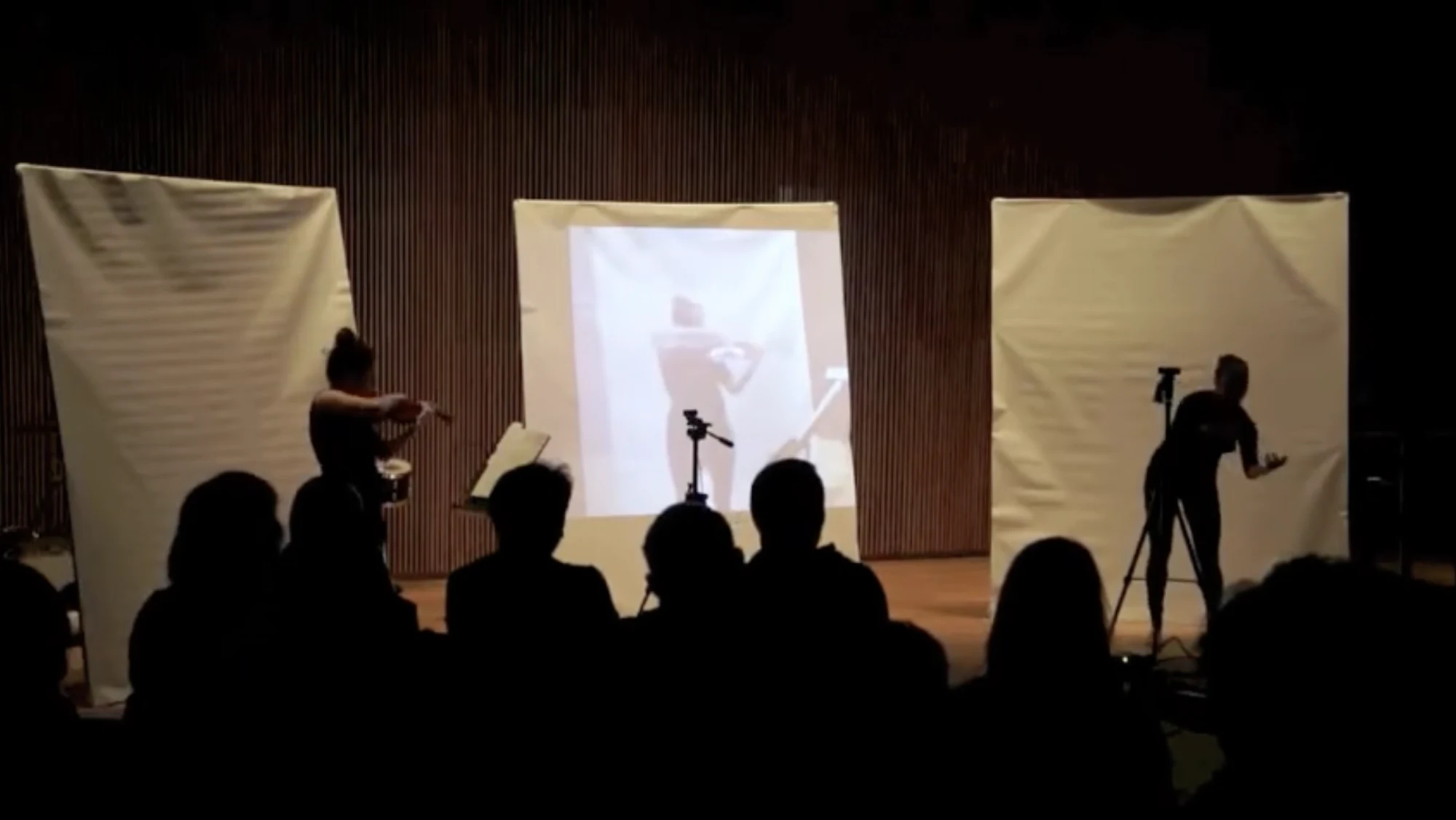
The work that followed this was (counter)Projections, my first venture into multidisciplinary performance – particularly, working with a musician, a dancer, and composed visual elements: a silhouette screen, live video projection, blocking, and light cues.
I’ve written extensively about this project in a previous entry. Being my first work that included a dancer, the sound-movement relationships here are very clear, perhaps to the point of redundancy. The work’s didactic opening establishes this interaction, opening up the possibility for sophisticated elaboration and subversion.
Recently, while discussing the piece with a close friend, I became aware of its structural strength. The combined use of staging, silhouetted performers, didactic structural signposts, and clear points of recapitulation (in both audio and visual domains) yield a discernible trajectory of the sound-movement narrative.
In a lesson with one of my teachers, they encouraged me to “obfuscate the relationship between the sound and the movement so much that the perceiver can no longer find it. Instead, they perceive a performance” (I’m paraphrasing). This piece of advice harks back to one of the tenants of modernism: avoid any clear elements that allow a perceiver to firmly anchor their frame of reference - any pattern that carries on a bit too long has the potential to become boring. Though I deeply admire this composer’s music and their capacities as a teacher and mentor, this advice comes with a grain of salt. I did want to break away from obvious movement-sound relationships, though I still wanted to create a loose but present thread to guide an audience through the performance. I guess it really depends on the nature of the audience, and what “perceiving a performance” means. Grisey knew that constant unpredictability becomes predictable, and the works of both Reich and Boulez are "perceived as performances". I guess I'm still scratching my head on this one.
Berlin, three years later…
In ironic erratic erotic, the support/subvert dichotomy was present in the methodology used to create the materials (described here), but they are obscured in the actual performance. Thus, this piece could come across as lacking the strong narrative arch found in (c)P. We don’t have as clear of a sense of what the piece is ‘about’, but rather the audience is left to solve this puzzle themselves, to find their own meaning in the complex interactions between the performers. The structure of the piece still makes use of traditional elements (repetition/recapitulation of cycles), but the moment-to-moment action hosts a more complex sense of spontaneity and mystery.
Perhaps a middle ground is needed – relationships that are simple enough to subvert in a creative, clever, and meaningful way, though complex enough to sustain a sense of intrigue – dramaturgy that compels and propels without pandering – didacticism without annoyance. If a work is meant to be completely self-referential (which is impossible…), it must have some degree of self-didacticism. If we’re lucky enough to draw an open-minded audience, we should at least give the audience an initial frame of listening. I’ll admit the silly titles of my pieces fail to do this (I guess I’m trying to avoid didactic titles), though I’m less afraid to overtly work this in to the fabric of the music itself.
Contextualizing this work into the rhetoric(s) of 20th/21st century music requires a bit of compartmentalization. With regards to its technical aspects and its problematization of sound and physical gesture through acoustic/live-electronic mediums (i.e. motion-sensors), one could draw links to the work of Laetita Sunomi and Thierry de Mey. If I look at the process in which the piece was created, one could see values present in the work of John Zorn. If I look at the acoustic and electronic sonic materials themselves, the balances between noise- and pitch-based sounds, there are influences of musique concrète instrumentale, Pierre Schaeffer, and the glitch/granulation textures common to users of Max/MSP. If you look at the relationships between the performers and their stage presence/sense of focus, one senses the performers-as-fallible-bodies notion of the “New Discipline”, etc, etc…
Clearly, this work doesn’t align itself cleanly into any one specific –ism, nor should it; the choices inform the genre, not the other way around. Though I wish performances of my work were more proliferated (don’t we all?), and I understand that the forces required to produce these performances are not exactly portable nor easily marketable. Of course, this leads into a long (and depressing) discussion of this music’s place in the economy and the academy, but I won’t get into that now. At this moment, I’m able to see a few loose ends that my work exposes, and different directions it can take, and suggestions for future experiments. And this brings me a little comfort.